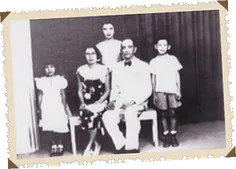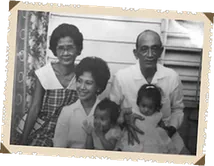
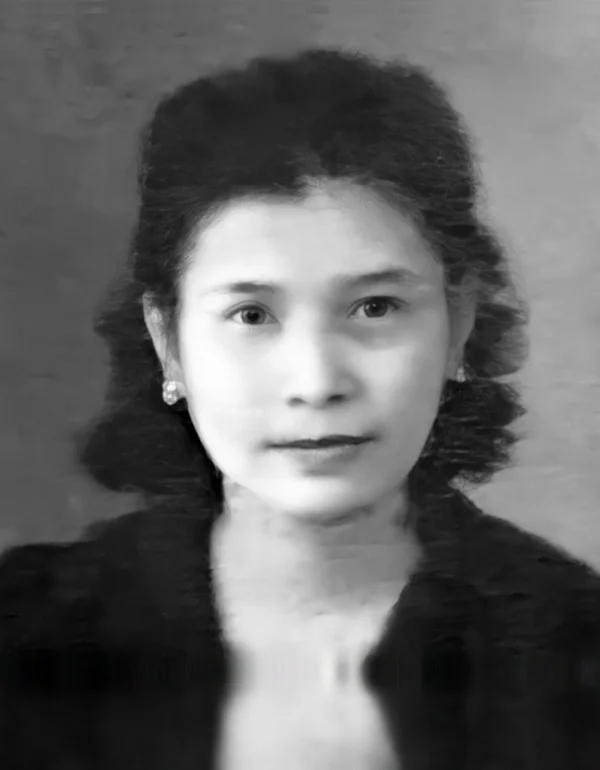
Adelaida Evangelista Santos Mansor
She was the socialite and family rebel of the Santos household, yet she also became one of its most successful daughters. Born Adelaida Leticia Santos y Evangelista—known in the family as Lola Dely—in Bulan, Sorsogon, on February 11, 1911, she was a granddaughter of Don Santiago “Capitan Tiago” Canciller Evangelista and Doña Maria Pilar Salunga y Dantis through her mother, Doña Natividad. She graduated from the University of Santo Tomas with a degree in Education, a rare achievement for a young woman of her generation, and on her twenty-third birthday in 1934 she eloped with Luis Mansor. The marriage, at first estranging her from her family, became the foundation of a flourishing life in Manila and left a prominent line of descendants.
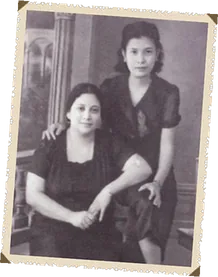
Adelaida belonged to the generation of women who became the living memory of the Evangelista clan. Together with her sisters Placer, Josefina, and Leticia, she was one of “the Lolas” remembered by the book’s author, Anna Viray-Cruz, as the kind, gentle ladies who told the younger generation stories about their ancestors, “particularly our Evangelista forebears who owned a large swathe of Candaba, Pampanga, in the 19th century.” Through their oral history, the figure of Capitan Tiago and the world of the Candaba Principalia passed from direct memory into family legend.
The Lolas were daughters of Doña Maria Natividad Canciller Evangelista y Salunga and Dr. Gualberto Santos y Zúñiga. Their mother had herself eloped, fleeing Candaba for Bulan, Sorsogon, after Doña Pilar disapproved of her match. That act of romantic defiance linked mother and daughter across a generation: both Natividad and Adelaida left their family home to marry the men they loved.
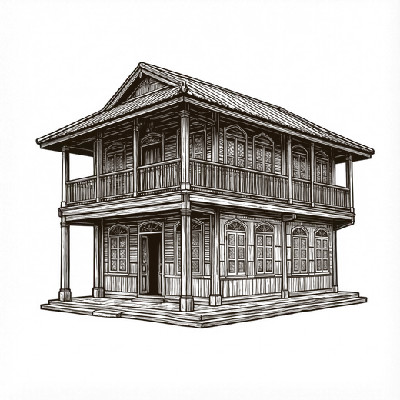
Adelaida grew up in a mansion that Filipino surveyor Don Timoteo Certeza described in his autobiography as “a big two story semi-concrete structure (Bahay na Bato) with a balcony and a ballroom that could hold a hundred people.” There was a piano in the spacious sala where Doña Natividad and her guests played classical music and sang. Dr. Santos established his medical practice in Bulan and became one of the leading physicians in Sorsogon; his wife, though often frail, presided over a household that combined medical learning, musical refinement, and the inherited grandeur of the Evangelista line.
Her brother Amado was the more serious and studious of the two boys, while Cesar was the more sociable. Her sisters Placer and Josefina, like Adelaida herself, were sent to the Colegio de la Inmaculada Concepción de la Concordia in Paco, Manila, where they absorbed the manners and discipline expected of young women of the Principalia.
Adelaida was one of six children who survived to adulthood. Her older sisters were Placer, born on September 25, 1906, and Josefina, born on September 27, 1908; her brothers were Amado, born in 1909, and Cesar, born on March 4, 1910. Adelaida Leticia followed on February 11, 1911, and the youngest sibling, Leticia, was born prematurely on March 28, 1926. Leticia survived only because her father created a makeshift incubator at home.
The Santos girls were raised to manage households, entertain guests, and maintain the social connections that sustained a family of their standing. Placer eventually became the main custodian of Doña Natividad’s portrait, which Doña Pilar had commissioned; she passed it on before her death in 2004 to her grandniece Baby Mansor. This small chain of inheritance—portrait, jewelry, memories—shows how the women of the family preserved its material and emotional heritage across generations.
Adelaida combined the aristocratic bearing of the Salunga-Evangelista women with an unusual drive for education. She graduated from the University of Santo Tomas with a degree in Education, at a time when young ladies of respectable families were often expected to marry rather than to complete a university course. Her degree gave her a measure of independence and prepared her for a life that would take her far from Bulan.
That independence showed itself most dramatically in her choice of husband. Her parents and family considered her still too young and not ready for marriage. On February 11, 1934—her twenty-third birthday—Adelaida eloped with Luis Mansor, and they were married at the Immaculate Conception Catholic Church in Bulan, the parish church of the Evangelista-Santos family. Her mother, Doña Natividad, died later that same year after a long illness.
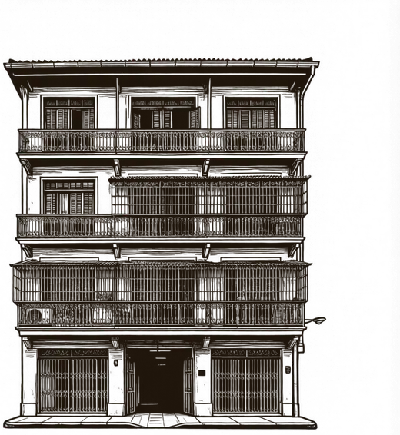
Adelaida and Luis Mansor built a life in Manila that reflected both their inheritance and their enterprise. Using their inheritance, they acquired a portfolio of land holdings and an apartment building that occupied half a block on Matimyas Street in Santa Mesa Heights, Quezon City. At a time when few women managed business affairs, Adelaida handled property and investments with the competence her grandmother Doña Pilar had shown in managing the Evangelista estate after Capitan Tiago’s death.
The couple had four children. Their eldest, Maria Angela Myrna, known as Baby, was born in Bulan on January 9, 1935. A son, Halim, followed in April 1937 and died in 1944. Another son, Elias, was born on January 12, 1941, and their youngest, Teresita, was born on January 9, 1945. Baby Mansor inherited her grandmother Doña Natividad’s musical gift and became an excellent pianist, playing classical pieces from an early age.
The family lived through the Battle of Manila in 1945 in their Matimyas Street house in Santa Mesa Heights. The war years also brought the wider Santos family closer. After the deaths of her parents and her brother Amado, and after the marriages of Cesar and Adelaida, only Placer, Josefina, and Leticia remained in the Bulan mansion. Placer, the eldest, eventually reached out to Adelaida and made peace.
Years later the three surviving Santos sisters—Placer, Josefina, and Leticia—made their last home in Parañaque, first in a house on Washington Street in Merville Park and later in United Parañaque I. None of the sisters learned to drive; they traveled by train between Bulan and Manila and relied on family and household help for errands. Their quiet, interdependent life reflected the strong sisterly bond that had carried them through decades of change.
Adelaida Santos-Mansor died on December 29, 1982, at the age of seventy-one, in the United Parañaque I house. Her husband, Luis Mansor, died peacefully on February 28, 1993.
Through her daughter Baby Mansor-Viray, Adelaida’s line continued to flourish. Baby married Wilfredo “Willie” Diño Viray, a naval officer from a political family in Sorsogon, and the Mansor-Viray family lived in exclusive Dasmariñas Village in Makati, with business interests in maritime shipping, yacht manufacturing, real estate, and other ventures. Willie Viray served two terms as president of the historic Army & Navy Club in Manila and received the Philippine Military Academy’s Cavalier Award for Private Enterprise from President Ferdinand Marcos. Baby was widowed in 1982 and later married her childhood sweetheart, Gonzalo “Lito” G. Puyat II. Adelaida’s descendants thus combined the Evangelista-Santos inheritance with new prominence in business, public service, and the professions.