Beatriz Evangelista y Castro
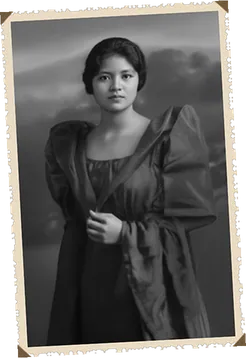
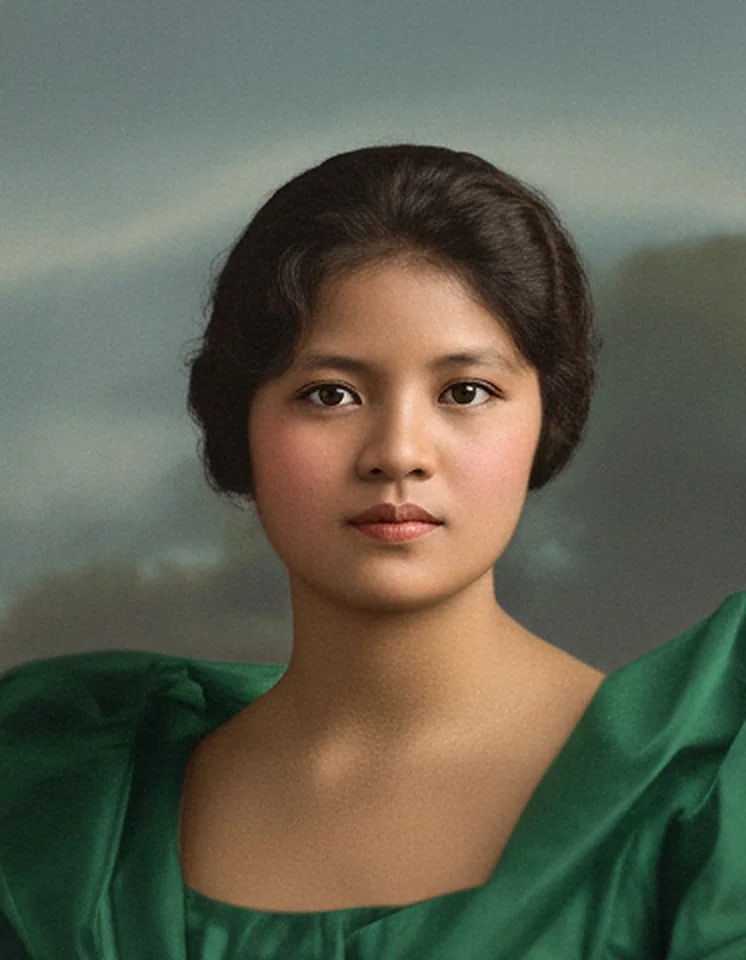
Beatriz Evangelista y Castro was one of four children of Don Pedro Canciller Evangelista and Doña Mercedes Castro y Constantino of Polo, Bulacan. Her father, the third son of Don Santiago “Capitan Tiago” Canciller Evangelista by his second wife, Doña Antonia Alonzo y de la Cruz, was a Municipal Presidente of Candaba and a Katipunero who risked his life for Philippine independence. Beatriz grew up in one of the most politically engaged branches of the Evangelista clan, surrounded by the revolutionary and civic legacy that her father and brothers would extend into the twentieth century. The family tree does not record a marriage or children for her, and the book names her only as one of Don Pedro’s four children, leaving the details of her own adult life unwritten.
Don Pedro Canciller Evangelista was born in Candaba on January 16, 1870, and baptized two days later at Candaba Church. He was eleven years old when his father was elected Gobernadorcillo, an event that must have made a profound impression on him. A staunch nationalist, Don Pedro became a member of the Katipunan in 1895 at the age of twenty-five, initiated by Dr. Pio Valenzuela y Alejandrino himself. Membership in the secret revolutionary society was dangerous: if caught, he could have been arrested, exiled, or killed, and his properties confiscated.
After the defeat of the First Philippine Republic and the end of Spanish rule, Don Pedro turned his energies to public service in Candaba. He married Doña Mercedes Castro y Constantino, whose sister Marciana was the wife of Dr. Pio Valenzuela. The couple had four children: Luz Sofronia, Aurora, Beatriz, and José. Beatriz thus grew up at the intersection of two notable families—the Evangelistas of Candaba and the Castros of Polo, both linked to the revolutionary generation.
Beatriz’s eldest sister, Luz Sofronia, was born in 1903; Aurora followed in 1905 and would become the mother of Dr. José Limjoco Evangelista, Jr. Their brother José, born after Beatriz, would become the beloved town doctor José Castro Evangelista, Sr., a civic figure so popular that he won election as Vice-Mayor in a landslide without campaigning. The family’s later prominence thus ran through Beatriz’s siblings and their children rather than through any recorded household of her own.
Growing up in this circle meant growing up with expectation. The Evangelista-Castro household was part of the Principalia that had ruled Candaba under Spain and continued to dominate its civic life under the Americans. Dinners, town fiestas, church processions, and political conversations would have formed the background of Beatriz’s childhood, even if the book does not preserve her own place in those scenes.
Don Pedro’s membership in the Katipunan gave the family a permanent place in the story of Philippine independence. The Katipunan, officially the Kataastaasang Kagalang-galang na Katipunan ng mga Anak ng Bayan, was a Filipino nationalist movement founded in 1892 to oppose Spanish rule. Many sons of wealthy families joined, risking everything for the cause. Don Pedro’s courage placed him in the company of his uncle Don Gregorio Canciller Evangelista, who had signed the Philippine Independence declaration sent by President Emilio Aguinaldo to foreign governments in 1898.
For Beatriz, this legacy meant that the family name carried both prestige and responsibility. Her father and uncle had helped shape Candaba through war and revolution; her brother and nephew would later shape it through medicine, education, and politics. Whether Beatriz herself took part in public life is not recorded, but she was heir to a family whose men were expected to serve the town.
Beatriz’s brother José Castro Evangelista, Sr., became one of the most beloved figures in Candaba’s twentieth-century history. He completed his medical studies but missed the opportunity to take the Philippine board examinations because of the Second World War, a lifelong regret that deeply impressed his son. Though he never accepted payment from the poor who came to him for care, he entered politics and won as Vice-Mayor in a landslide while his party mates were defeated. When townspeople urged him to run for Mayor, he politely refused.
After his early death at fifty-five, his widow Doña Aurora Limjoco-Evangelista founded the Unisite Learning Center in San Fernando, Pampanga, in 1988. Their son, Dr. José Limjoco Evangelista, Jr., born in Candaba on January 21, 1944, became an internationally celebrated cardiologist and philanthropist, continuing the family’s public service across the Pacific. Beatriz’s nephew Cenen Evangelista and other relatives also remained active in Candaba’s civic and educational life.
Whatever the details of her own life, Beatriz belonged to a branch of the Evangelista family that left a deep mark on Candaba and beyond. Her father served as Municipal Presidente and fought for independence; her brother healed the poor without charge and won public office; her nephew became a world-renowned cardiologist; her niece founded a school. These achievements, recorded in the book’s chapters on Don Pedro and his descendants, form the larger legacy within which Beatriz’s name is preserved.
In that sense, Beatriz represents the many women of the Principalia whose names appear in family records as daughters and sisters, anchoring kinship networks even when their individual stories were not written down. Her connection to the Evangelista-Castro line keeps her linked to a clan whose members served Candaba as municipal presidents, physicians, educators, and benefactors for more than a century.