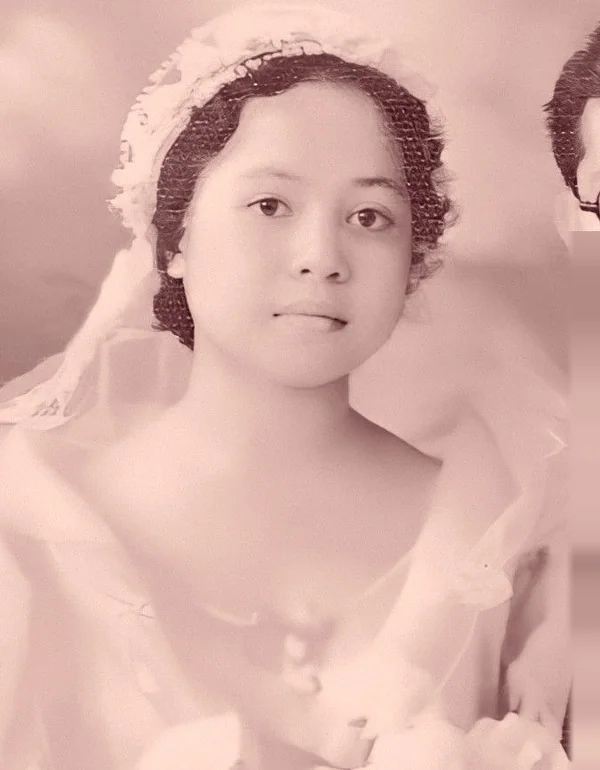
Corazon Ranara-Evangelista
From one of the founding families of Mahinog, Camiguin, she married the pharmacist Tomas Evangelista and was widowed at twenty-three when the April 1944 storm took her husband, her father, and a brother off Camiguin Island. A courageous mother who raised Ambrosio and Zenaida in Candaba among their Evangelista aunts, she later joined her children in the United States and guided them through every difficulty, living to see the rewards of all their hard work.
Corazon Baño Ranara was born on August 28, 1920, into one of the families that helped found the municipality of Mahinog in the province of Camiguin. Her parents were Marcelino Ranara and Bernardina Baño, members of a prominent local line whose name is tied to the early civic life of the island town.
The Ranaras were not merely residents of Camiguin; they were counted among its founders. This background placed Corazon within a circle of families accustomed to responsibility and public standing, a formation that would later sustain her through sudden widowhood and emigration. The book does not record her schooling or her activities before marriage, but her family position made her a suitable match for an educated Evangelista from Candaba.
Tomas Evangelista y Gumabon, a pharmacist trained in Manila and the adventurous son of hacendero Don Ambrocio Canciller Evangelista, had established himself on Camiguin in the 1930s. There he founded the Laboratorio de Evangelista, producing tablets, cures, and tonics that drew customers from neighboring islands as far away as Cebu, some 142 miles across the sea.
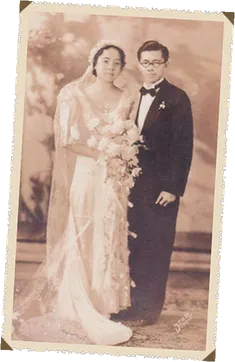
The highly eligible bachelor met and married Corazon Ranara y Baño. Their union joined the Evangelistas of Candaba, descendants of Capitan Tiago, with the Ranara founders of Mahinog. The couple began their family in the south, away from the Pampanga ancestral house but very much within the widening orbit of the Evangelista clan. Their wedding photograph, taken on Camiguin Island, preserves the moment when the two island families became one.
On April 17, 1941, Corazon gave birth to a son, Ambrosio. That same year Tomas purchased land in Midsayap, Cotabato, a sign that he intended to deepen his roots in Mindanao just as his forebears had in Candaba. On June 24, 1943, a daughter, Zenaida, was born, completing a household that seemed poised for prosperity.
With a burgeoning enterprise and a growing family, Tomas had much to look forward to. Corazon, still in her early twenties, was building a home in a landscape of fishponds, volcanic soil, and inter-island trade. The future appeared to follow the same pattern of land, profession, and family that had served the Evangelistas for generations. The book gives no further details of their domestic life, but the sequence of births and land purchases shows a couple planning for permanence.
After the end of the Second World War, Ambrosio was sent to Candaba to live with his Evangelista spinster aunts. Little Zenaida missed her brother so much that she called out his name every day. Corazon finally relented, and mother and daughter traveled to Candaba, where the family was reunited.
Coming from a brood of twelve children born to Don Ambrocio Canciller Evangelista and Doña Juanaria Gumabon, Tomas had no shortage of siblings who could help raise his two children. Four of his sisters never married, and two of them—the beautiful Ester and the strong-willed Pacifica—played a significant role in the upbringing of Ambrosio and Zenaida. Their nephew and niece surely reminded them of their brother, and through his children Tomas continued to live on.
The children grew up in the large bahay na bato on Pescadores Street, later renamed Evangelista Street, a house so fine that some scenes of the 1961 film Noli Me Tangere were filmed there. Though Ambrosio and Zenaida never met their grandparents, they lived surrounded by their portraits, their aunts' strict care, and the fruit trees of the family orchard.
Zenaida recalled what fun it was to grow up with numerous cousins living nearby. There were weekly family get-togethers. At Christmastime, their aunts would take Zenaida and Ambrosio and walk over to the homes of relatives to greet the elders of the Evangelista Clan as a sign of respect. The season of Christmas and New Year was marked with reunions, dancing, and great merriment.
During the rainy season, the Pinac de Candaba, now known as the Candaba Swamp, would flood and the waters would get very deep. The children and their cousins would take boat rides there and snack on hominy corn. Locals who caught a glimpse of them, all possessing the Evangelista or chinito eyes, would exclaim, 'There goes the Chinese!' A member of the boating party would always have a parting reply. These small memories give a rare picture of Corazon's children at play in the town.
The two aunts took prodigious care of their young charges. According to Zenaida, they were very strict and very proper ladies, well-mannered, and quite overprotective. The children were not permitted to eat street food sold by vendors around Candaba, especially during town fiestas. The aunts insisted on home-cooked meals to ensure the quality of ingredients and cleanliness.
They tried to instill good values and proper conduct in their nephew and niece. Zenaida began piano lessons in her teenage years, continuing the tradition of many Evangelistas; her favorite piece was Chopin's Polonaise in B-flat major. Her brother Ambrosio studied the violin. These refinements were part of the upbringing Corazon entrusted to her husband's sisters.
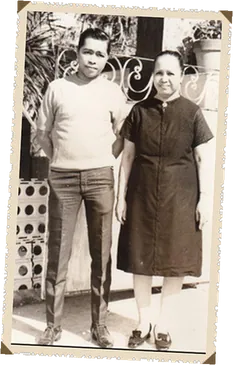
Corazon's courage carried the family through the difficult decades. Ambrosio became an electrical engineer and married Elena Co y Gallardo in Camiguin in 1973 before moving to California; their children are Alvin Clyde and Arlene Carol Evangelista y Co. Zenaida studied nursing and became a registered nurse; she married Jesse Sabino y Ymson and bore two daughters, Evelyn and Emily. Zenaida was widowed in 1998.
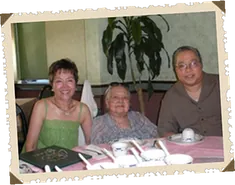
Corazon eventually joined her children in the United States, where she lived long enough to see Ambrosio and Zenaida reap the financial rewards of their hard work. Brother and sister still own the Evangelista ancestral land in Candaba that they inherited from their father Tomas's estate, one of the few remaining Evangelistas to do so.
She died on February 23, 2011, in Los Angeles, California, in her ninetieth year. She had guided her children through every difficulty, and under her steadiness they had weathered them all. From the founding families of Mahinog to the Evangelista mansion on Evangelista Street, and finally to California, Corazon's life traced both the losses and the quiet triumphs of her generation.