Pacifica Evangelista y Gumabon
Aschoolteacher of Candaba for many years, she shaped the minds and hearts of the town's youth and donated the land on which a school was built, though it was never named in her honor. Strict and highly moral, she also helped raise the two children of her brother Tomas after his untimely death in 1944.
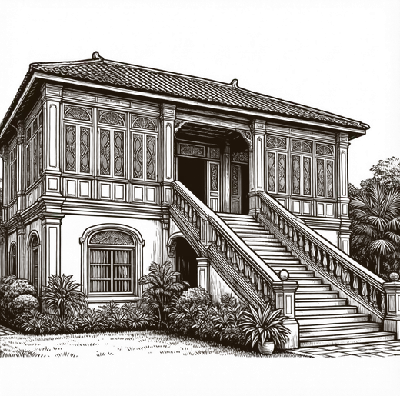
Pacifica Gumabon Evangelista was born in Candaba, Pampanga, on September 25, 1913, one of twelve children of Don Ambrocio Canciller Evangelista y Alonzo and Doña Juanaria Gumabon y Guevarra. Her father was a fifth-generation hacendero who had built one of the largest bahay na bato houses in Candaba, on what is now Evangelista Street.
Doña Juanaria came from nobility; she was the daughter of Don Antero Gumabon y Dalusuno and Doña Alipia Guevarra y Gatbonton. The family's standing gave Pacifica and her sisters a secure position in town society. Don Ambrocio passed away on August 14, 1936, and Doña Juanaria followed on November 29, 1936, leaving their children to carry on the household and its traditions. Pacifica was twenty-three when her mother died, an age at which she would already have been formed by the family's values.
Don Ambrocio's other daughters never married after he told them that they had no need for husbands to support them. The book notes that among his daughters, Ester was known as a great beauty, so striking that whenever she stepped out of the house the townsfolk would stop and stare. Ester died on July 26, 1970, after suffering a stroke.
Pacifica and three of her sisters listened to their father's advice and remained single. Instead of leading idle lives, they devoted themselves to other pursuits. For Pacifica, this meant entering the honorable profession of teaching and using her inheritance for the benefit of the town's schoolchildren. The decision was presented not as a resignation but as a positive choice to serve.
The bahay na bato built by Don Ambrocio was a large two-story house set on a parcel easily covering three lots. It had both floors fully equipped with their own kitchen and living quarters, with staircases at the front and back. The Sala was decorated with antiques, including large portraits of Don Ambrocio and Doña Juanaria.
An orchard on one side of the property held chico, sineguelas, macopa, santol, sampaloc, cacao, suha, and caimito trees. Scenes from the 1961 film Noli Me Tangere were filmed at the house. Pacifica lived in this setting throughout her adult life, and it forms the backdrop of the surviving photographs of her later years. The street itself was renamed Evangelista Street because most of Don Santiago Canciller Evangelista's children built mansions there.
The Spaniards brought Catholicism to the Philippines; the Americans brought their system of public education. In 1901 a group of six hundred American teachers arrived in the Philippines on board the U.S. Army Transport Thomas and were thereafter known as the Thomasites. Three Thomasites went to Candaba to train local teachers and put up schools.
The Evangelista Clan played a pivotal role in the education of Candaba's children. After Don Pedro Canciller Evangelista was elected Municipal Presidente in 1908, local schools were established in several barrios including Bahay Pare, Lanang, Salapungan, and Mandasig during his term. Pacifica's teaching career unfolded within this network of schools supported by her own family.
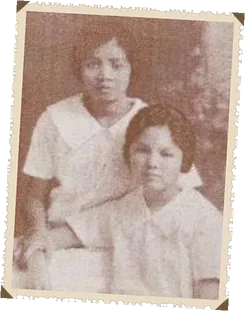
Pacifica took up the honorable profession of teaching at one of the town's schools. A 1948 photograph shows her with her Second Grade students at Candaba Central School. She appears as a strict and highly moral woman, resolved to help shape the minds and hearts of Candaba's youth. Another photograph shows her with fellow teachers at Candaba Elementary School, part of the daily life she chose over marriage.
The book describes her as intelligent and well-brought up, a woman of substance who used her position to serve the next generation. Her classroom was one of the places where the American-era expansion of public schooling in Candaba took concrete form. She also helped shape the character of her nephew and niece after their father's death.
When Pacifica's brother Tomas Evangelista died at sea in April 1944, he left a young widow, Corazon, and two small children, Ambrosio and Zenaida. After the war, Ambrosio was sent to Candaba to live with his Evangelista aunts, and soon Zenaida and Corazon followed.
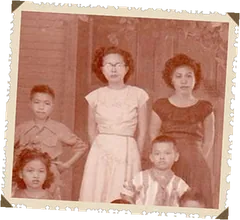
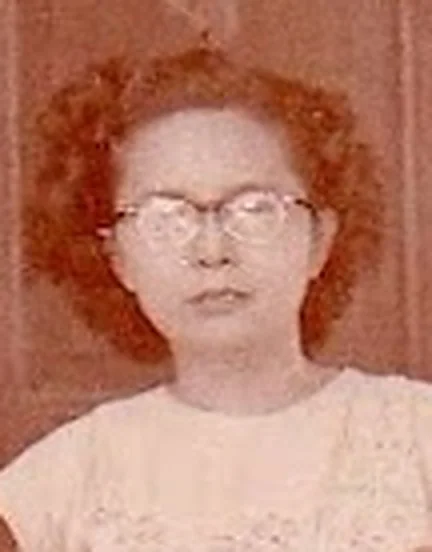
Pacifica and her sister Ester played a significant role in raising the children. A photograph from the early 1950s shows Pacifica, wearing eyeglasses in the back row, second from left, with her charges Ambrosio and Zenaida. She is described as the wise and strict steward of her brother's children, and another image shows her in the family bahay na bato with Elena Co-Evangelista, the wife of her nephew Ambrosio.
Through her care, Tomas's children were raised within the Evangelista household on Evangelista Street, surrounded by cousins, aunts, and the memories of their grandfather's generation. Pacifica ensured that her brother's memory lived on in the education and upbringing of his son and daughter.
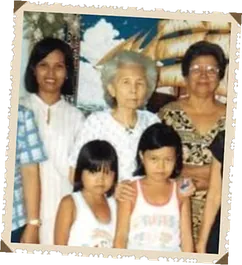
Pacifica Evangelista y Gumabon died on October 19, 1989, from ovarian cancer. An elderly photograph shows her as a gray-haired lady in the bahay na bato of her father, Don Ambrocio Canciller Evangelista, on Evangelista Street.
The book memorializes her under the heading 'Pacifica Evangelista y Gumabon: Un Noble Legado.' It calls her a woman of substance who lived a life of service, teaching Candaba's youth and helping to raise her brother's children after his untimely death. The final wish expressed for her is that a school will one day bear her name, honoring both her donation and her years of service.