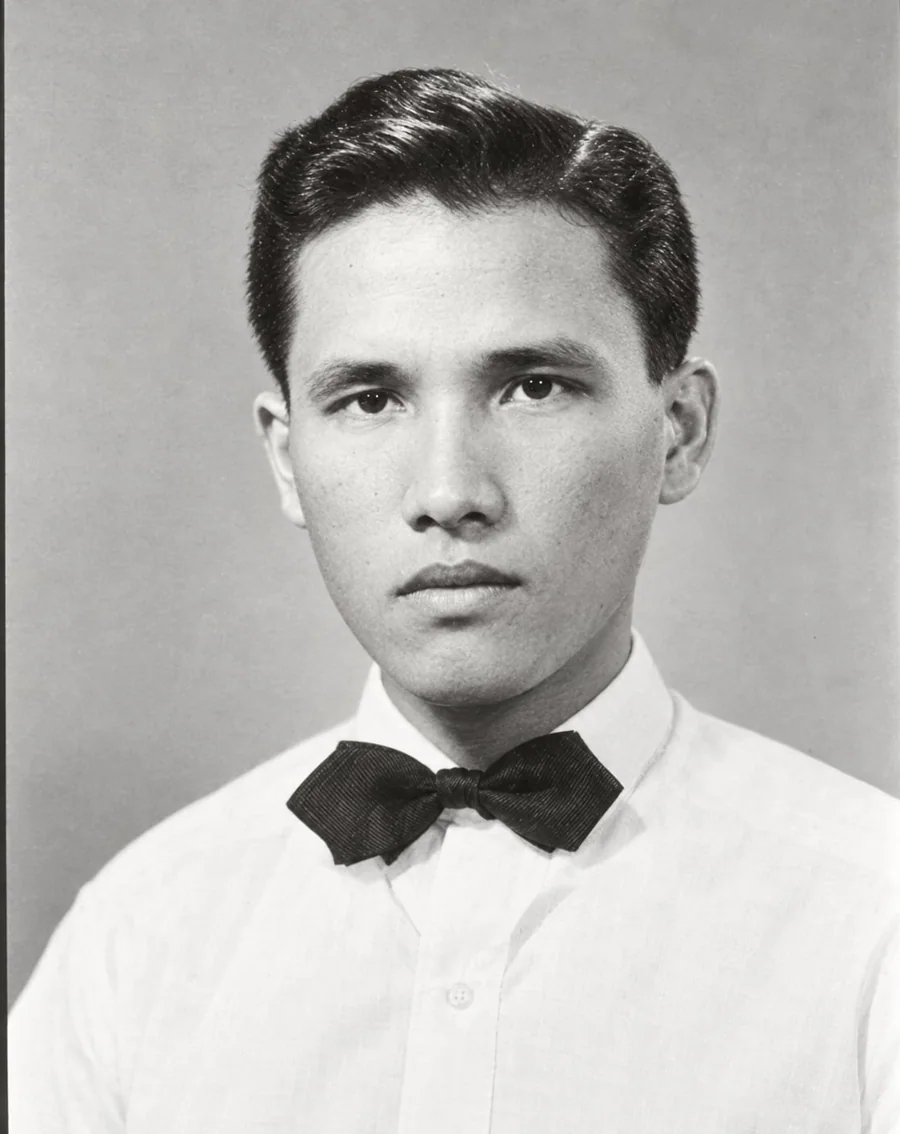
Dr. Rene Castor y Evangelista
Dr. Rene Castor y Evangelista belonged to the generation of Evangelistas who translated inherited prestige into the urgent public work of the 1960s. A physician and the son of Aurora Evangelista-Castor and José Castor, he was a grandson of Municipal President Don Pedro Canciller Evangelista. When Mayor Anastacio Gallardo was assassinated by the Huks in 1966, Rene succeeded him as Mayor of Candaba, serving from 1966 to 1968. He married his fellow doctor Mercedez Domesag, linking the Evangelista political line to the medical profession once again.
Rene’s mother, Aurora Evangelista y Castro, was one of the four children of Don Pedro Canciller Evangelista and Doña Mercedes Castro y Constantino. Don Pedro, a Katipunero initiated in 1895 and Municipal Presidente of Candaba from 1908, had built a public legacy that would reach through his grandchildren. Aurora married José Castor, and together they had seven children: Mercedes, Rene, Violeta, Lilia, Wilfrido, Romeo, and Placer Castor y Evangelista.
Through this marriage, Rene was connected to both the Castro and Evangelista branches of the family. His uncle, José Evangelista y Castro, was the town doctor and Vice-Mayor of Candaba. His first cousin, Dr. José Evangelista y Limjoco, would later become the celebrated cardiologist known as Dr. Joe. The expectation of service ran in Rene’s blood from several directions.
Rene chose medicine and married a fellow physician, Dr. Mercedez Domesag. The book mentions the marriage briefly as a fact, without elaborating on where they trained or how they met. That they were both doctors places Rene in a family pattern: his grandfather Don Pedro had married into the household of Dr. Pio Valenzuela, his uncle José had been the town doctor, and his cousin José Jr. would rise to international prominence in cardiology.
The book does not name any children of Rene and Mercedez, nor does it trace their later residence. What remains is the clear record of a professional partnership between two doctors, one of whom was called, almost overnight, from the clinic to the mayor’s office.
Anastacio Gallardo, who had served multiple terms as Mayor of Candaba and was married to Asuncion Evangelista y Lacanilao—the adopted daughter of Don Honorio Canciller Evangelista—was active in politics from the 1940s through the 1960s.
In 1966 Dr. Rene Castor y Evangelista, grandson of Don Pedro, succeeded Gallardo in the mayor’s office and held it from 1966 to 1968. The book does not describe the policies of his brief administration; it records the fact of succession. The transition from a mayor’s office to a physician-mayor reflects the family’s habit of stepping forward when Candaba needed leadership.
Anastacio Gallardo entered the Evangelista circle through marriage. His wife, Asuncion Evangelista y Lacanilao, was the adopted daughter of Don Honorio Canciller Evangelista, Don Pedro’s younger half-brother. Gallardo served as Mayor of Candaba in the 1940s, 1950s, and 1960s. The couple had nine children: Corinne, Brenda, Melanie, Mary Jane, Irvino, Ramon, Gizelle, and Cheryl Gallardo y Evangelista.
Because Asuncion belonged to Don Honorio’s line while Rene belonged to Don Pedro’s, the succession from Gallardo to Rene also represented a passing of authority between two branches of the Evangelista clan. The Huks who killed Gallardo were communist rebels; the murder was part of a broader wave of lawlessness that President Marcos had summoned central Luzon mayors to discuss.
Rene’s cousin, Dr. José Evangelista y Limjoco, was born in Candaba on January 21, 1944, the son of José Evangelista y Castro and Aurora Limjoco. While Rene was finishing his brief term as mayor, Dr. Joe was beginning the medical studies that would take him to the United States. In 1968, Dr. Joe and his wife Dr. Stella Salgado-Evangelista paid their respects to their great-granduncle Don Honorio Canciller Evangelista in San Francisco on the very day they landed for postgraduate studies.
The two cousins—one a mayor in a disrupted town, the other a young cardiologist setting out for the world—show how the Evangelista medical and political traditions ran on parallel tracks. Both were grandsons, in different ways, of Don Pedro’s vision of service.
By the time Rene became mayor, the Evangelistas were already dispersing. The book notes that beginning in the late 1940s, with Dr. Honorio Canciller Evangelista’s move to San Francisco, a steady emigration of descendants carried the family to California, Washington, Michigan, New York, and beyond. Those who remained in Candaba continued to hold office and tend the ancestral barrio of Pescadores.
Rene’s term therefore belonged to the last phase of concentrated Evangelista political power in Candaba before the diaspora accelerated. Within a generation, Benjamin’s grandson Emerson would win a barangay chairmanship in Pescadores, but the era of mayors and municipal presidents drawn directly from the Candaba estates was drawing to a close.