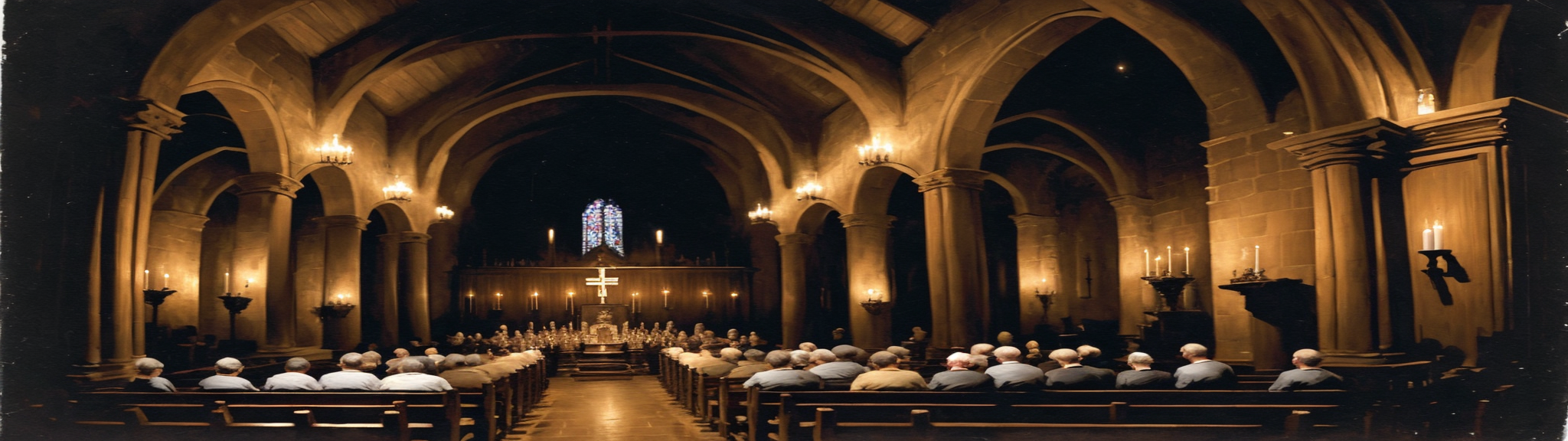
If you ever find yourself in Candaba, Pampanga during Holy Week, don't miss the Good Friday town procession. For the last 250 years, the Evangelista Clan has played an important part in this procession. As one of the Principalia families during the Spanish Colonial Rule, the Evangelistas have always been one of the major sponsors of this event.
A Family Heirloom
The Principalia owned the ornate carrozas, usually made of pure silver encrusted with jewels, which carried the families’ prized santos (religious statues) with heads and hands made of ivory, dressed in intricately embroidered silks and velvets. The Evangelistas of Candaba owned several of these santos that were used during the processions, a statue of Mater Dolorosa among them. Mater Dolorosa, Latin for Mother of Sorrows, is one of the oldest titles of the Blessed Virgin Mary. In religious art, she is depicted with an anguished look on her face and with a large dagger, or sometimes with seven daggers symbolizing her Seven Sorrows, piercing her Immaculate Heart. Of all the Marian devotions, it is Our Lady of Sorrows who is the Queen of the Evangelistas of Candaba by virtue of an ancient statue that has been in the clan for over 100 years.
In the 1895 settlement of Don Santiago Canciller Evangelista’s estate, included in the inventory of the contents of the conjugal home on Calle Real were two statues of the Blessed Virgin Mary, her accessories, and her custom silver carroza used during town processions. Back then, the statues and carroza were already considered heirlooms. While his eldest son, Don Emiliano Canciller Evangelista inherited his father’s mansion, Don Santiago’s young widow Doña Maria Pilar Salunga y Dantis inherited its contents, including all of Don Santiago’s santos. Doña Pilar then had at least two suitable houses built in Candaba, one on Buas Street which is within the town proper, and another on the outskirts of town, on agricultural land she inherited from her late husband, overlooking some of her fishponds. The bahay na bato on Buas Street is walking distance to the Candaba Church, and the mansions of Doña Pilar Evangelista’s stepchildren on Encarnacion Street and Pescadores Street (now Evangelista Street).
It was in the bahay na bato on Buas Street where Mater Dolorosa took her place as the Queen of the house of the Evangelistas, literally and figuratively. Her sanctuary ever since is a two-story concrete (ground floor) and wood (second floor) house in the classic Filipiniana style. The Evangelistas’ arquitectura mestiza, also known as the ancestral house, is resplendent with large concha or latticework panels that frame the capiz (oyster) shell sliding windows, the ventanillas beneath the windows, and the intricately-designed calado (wooden fretwork) above it, that wrap around the second floor. The architectural features of the bahay na bato are not only for aesthetics but they provide practical purposes as well. The capiz shell windows are very wide which allows for unobstructed views of the outside, quite beneficial during town processions. The ventanillas or “little windows” located between the window sills and the floor allowed Doña Pilar’s children Doña Rosario, Doña Natividad, Don Honorio, Don Jose, and Doña Virginia Canciller Evangelista y Salunga to see outside and were protected from falling out by the hand-carved wooden balusters called barandillas. During siesta or afternoon naps, the children slept comfortably by the ventanillas enjoying the cool breeze. The calado pierced wooden panels above the capiz shell windows not only greatly enhanced the character of the house but provided additional lighting and ventilation as well. Since heat rises, the calado allows the humidity to escape the house. The media aguas (roof shed), metal roof that protects the windows from rain or heat are supported by slender iron braces which seem to delicately branch out of the second story’s wooden frame. To say that the house is beautiful is an understatement. It is a house befitting the statue of the Mother of God that is kept there.
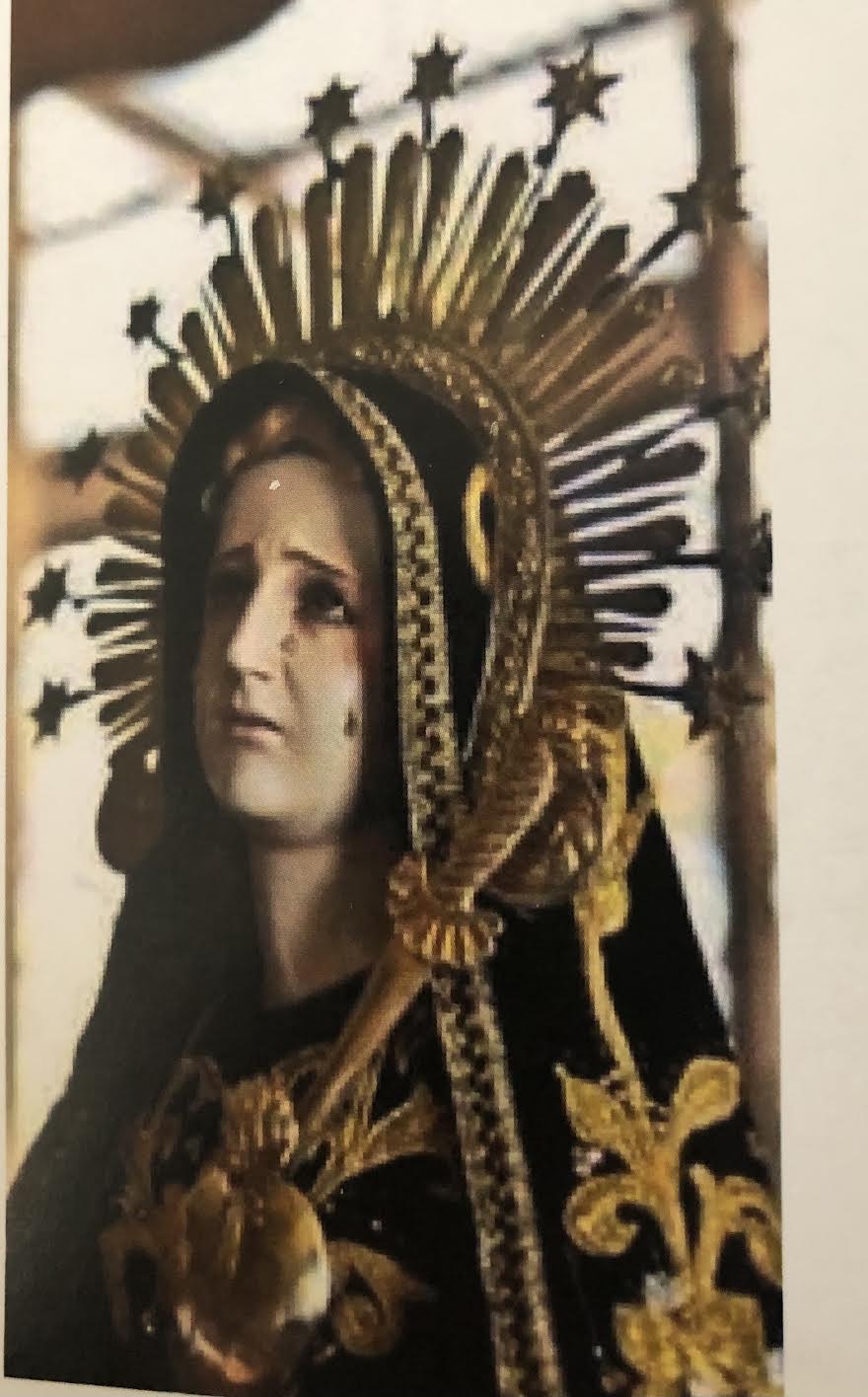
The Evangelistas’ ancestral Mater Dolorosa statue is unique in that it has two heads: one has a sorrowful ivory face used on Good Friday, and the other has a joyful face (Alegria) used during the Easter celebrations. She is life-size, standing approximately 5 feet tall. She has a wooden body with a base. Her ivory clasped hands as if in perpetual prayer, a gold sword pierced into Her heart. Mater Dolorosa’s wardrobe consists of a luxurious long black velvet dress accented with ornate gold embroidery. The two ivory heads, ivory hands, and the sword are all removable.
Through the Generations
The Principalia rule ended in 1898 with the defeat of the Spaniards in the Spanish-American War. Under the Americans, many old Spanish traditions were sadly lost. The town processions was one of the traditions that survived and continued by the descendants of the old Principalia families, the related clans of the Evangelistas of Candaba and Angeles City among them. Don Roman Evangelista, the very wealthy patriarch of the Angeles City, Pampanga branch commissioned their Santa Misericordia, a tableaux that depicts figures of the crucified Lord Jesus Christ flanked by Mater Dolorosa and San Juan (St. John the Beloved Apostle), which were completed in 1907. Thereafter it became a permanent fixture of that city’s Good Friday processions along with other statues, 16 in total in one enormous carroza, commissioned by Don Roman and his wife Doña Francisca de la Resma. In Candaba, when Mater Dolorosa processed through the streets of Candaba at the turn of the 20th century, Doña Pilar and her children, as well as her Evangelista stepchildren would have likely followed behind her carroza.
When Doña Pilar’s son Dr. Honorio Canciller Evangelista inherited the ancestral house on Buas Street after her death in November 1931, he also inherited Mater Dolorosa. His wife Carmen Lacanilao-Evangelista had a deep devotion to Mater Dolorosa and made a panata (vow) to honor her as the Patroness of her family. She passed on this devotion to their two daughters Asuncion (Sunny) and Leonor (Nonong) Evangelista y Lacanilao and, being a hands-on grandmother, to their children. Asuncion, who was Carmen Lacanilao’s child from a previous marriage and was legally adopted by her stepfather Don Honorio, lived in the ancestral house with her husband Anastacio Gallardo who served three terms as Mayor of Candaba from the 1940s to the 1960s. The Evangelista-Gallardo children were reared there. Asuncion’s younger half-sister Leonor married Atty. Emmanuel Jacinto y Tinawin and they lived in Quezon City. Leonor, a gifted musician and singer, raised their children not only to love the arts but more importantly, to have a deep abiding Faith. Every summer the Evangelista-Jacinto children stayed at the ancestral house with their cousins. Mater Dolorosa was always a part of all of their lives. One might say, the grandchildren of Don Honorio and Carmen Evangelista grew up under the watchful eyes of Mater Dolorosa.
Emylene E. Jacinto-de Jesus and her younger sister Deborah (Debby) Jacinto y Evangelista, two of Leonor Evangelista-Jacinto’s children, have the fondest memories of their summers at the ancestral house which sits on an expansive lot where they used to play games, and lived in close quarters with Mater Dolorosa. As soon as the academic year ended at their school, the Assumption Convent on Herran Street, Malate, Manila, they hied off in a bus from their home in Quezon City to Candaba along with their Lola Mameng Evangelista (Carmen Lacanilao-Evangelista). The bus would invariably stop in Malolos, Bulacan, where they would buy tiny pan de sal (local bread) and drink fresh buko juice straight from the coconut husks. The girls knew then they would soon be reunited with their aunt, uncle, cousins, and the larger Evangelista Clan.
At the ancestral house, the Evangelista-Jacinto sisters happily recalled picking the fruits off the caimito (star apple) tree in the front yard from the second story windows using a sungkit (a pole with a hook attached on one end). The star apple must have been one of the fruits favored by earlier Evangelistas such as their grandfather Don Honorio who may have employed the sungkit himself along with his siblings decades earlier. The sisters remembered the manual water pump on the property which was such a novelty for them since they were “Manila girls,” and lots of kundol (wax or winter gourd) stored in the silong (lower level) of the house. The silong is where the carroza of Mater Dolorosa is kept. The house witnessed many milestones in their young lives, including a rite of passage when they had their ears pierced using threads and mercurochrome antiseptic. In the 1950s, the sisters, along with their first cousin Jeanette Gallardo y Evangelista (now Mrs. Agripino Magbitang, Jr.) donned their first formal long gowns when they participated as “Sinyuras'' in Candaba’s Easter Salubong procession. The Salubong (Welcome) reenacts a traditional Filipino devotion: the encounter of the risen Christ with His Mother (Mater Dolorosa).
After the death of Carmen Lacanilao-Evangelista (1903-1995), her daughters Asuncion Evangelista-Gallardo (1919-2016) and Leonor Evangelista-Jacinto (1924-2017) continued to maintain the ancestral house and the care of Mater Dolorosa with the help of their children. Over the decades, the ancestral house evolved with the times. An additional wing was added that altered it into an L-shaped house. Through all these years, Mater Dolorosa has refused to leave the ancestral house and Candaba. Attempts to take her out of Candaba have all failed no matter how many men were employed to try to lift her! She made herself too heavy for that moment, and refused to budge! Her Alegria head, however, has been in the safekeeping of a member of the clan in Southern California for several years now. When not blessing the town in Her carroza, parts of Mater Dolorosa are kept in a vault in another part of Candaba. If you visit the Candaba Church, you will see a replica Mater Dolorosa statue donated by the Evangelista-Gallardo family.
Long May She Reign
After Leonor’s death in 2017, the ancestral house and Mater Dolorosa were formally transferred to Asuncion Evangelista-Gallardo’s descendants. With most of Asuncion’s family living overseas, today her son Irving (Bing) Gallardo y Evangelista lives in the ancestral house and is the guardian of Mater Dolorosa with his siblings making their annual pilgrimage to Candaba for Holy Week no matter where they are in the world. It’s thanks to their devotion and commitment to Mater Dolorosa that She continues to grace the town processions. They all have experienced the blessings She has brought to their lives. They do an excellent job taking care of Mater Dolorosa, ensuring Her carroza is beautiful for the event. They have maintained the ancestral house, Mater Dolorosa’s house, as well.
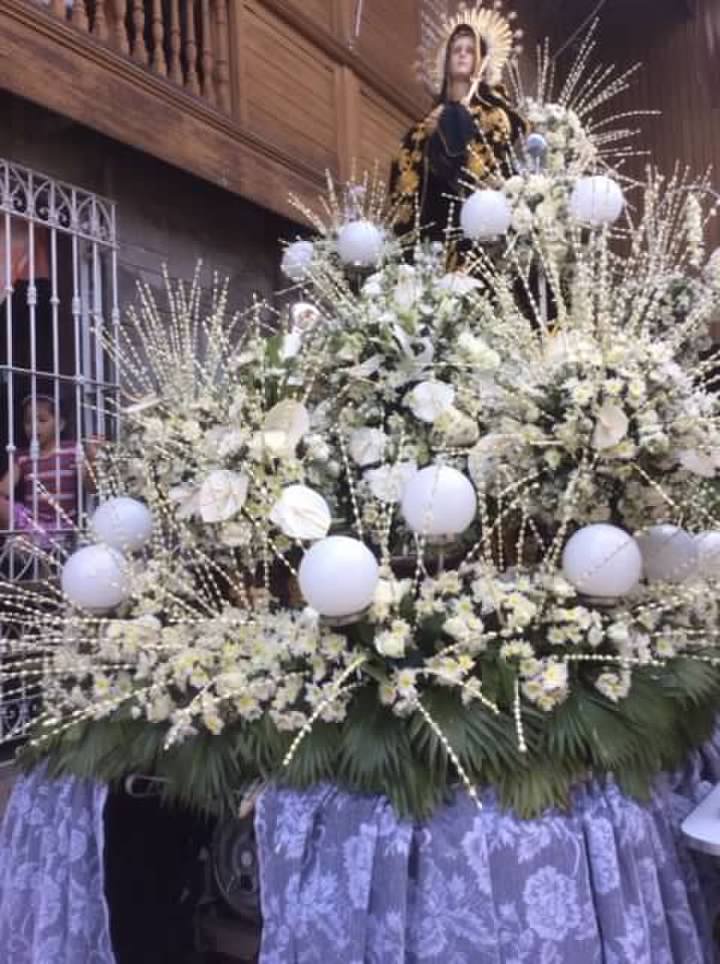
History and traditions are very important to know, and learn from. It helps us understand who our ancestors were, and appreciate all the good they did. We have so much to be grateful for, especially for Mater Dolorosa who continues to show each of us the sure way to Her Son. Long may Mater Dolorosa reign in Candaba and in the hearts of all Evangelistas!
Draw us after you, O Virgin Mary, we will follow in your footsteps.
- From the Discalced Carmelites’ Antiphon for the Solemnity of Our Lady of Mount Carmel