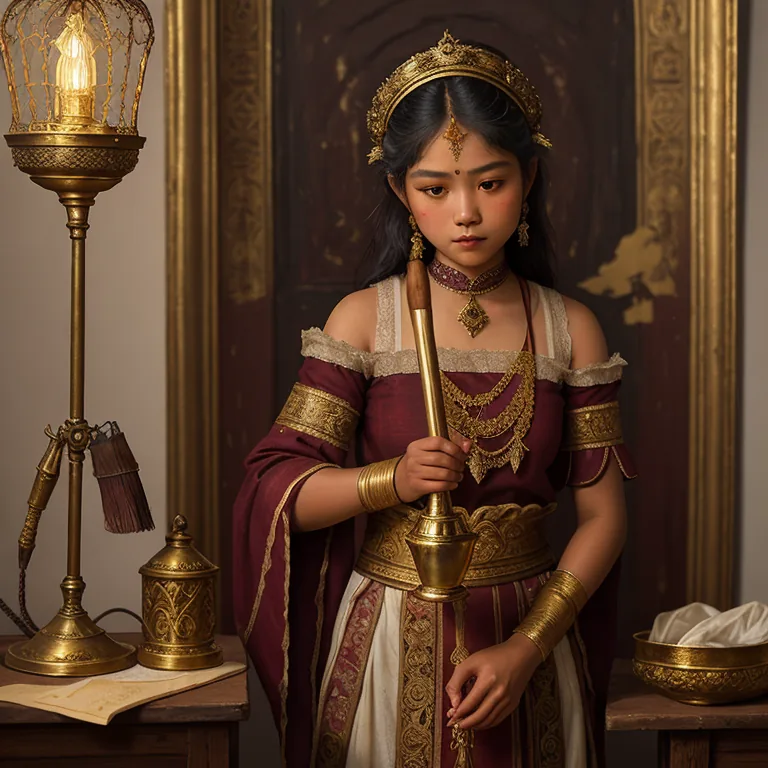
The year is 1903. Doña Maria Pilar Salunga viuda de Evangelista of Candaba, Pampanga, and her 14-year-old daughter Doña Maria Natividad Canciller Evangelista y Salunga sat for their studio portraits. Their photographs, in black and white, were then hand-coloured by an American artist whose name has long since been forgotten. The paintings were completed in 1904.
The Portrait
This is the story of restoration…of one of the paintings, and the beautiful woman behind that portrait.
Restauracion de Natividad.
Dedicated to the memory of Placer Santos y Evangelista, who was affectionately called Lola Baba, Natividad’s eldest child and custodian of her mother’s portrait for about 70 years. A very aristocratic lady who lived to be nearly 100 years old, she was known for her regal bearing, and was a genuine and caring person to everyone.
Lola Baba and her five siblings Josefina (or Lola Pining), Amado (or Lolo Amading), Lolo Cesar, Adelaida (or Lola Dely), and Leticia (or Lola Nene) Santos y Evangelista were born and raised in Bulan, Sorsogon, where Natividad and her husband Dr Gualberto Santos y Zuñiga eloped to in 1904, around the time the portraits were completed.
Doña Natividad was born on February 13, 1889, in Candaba, Pampanga. Her father, Don Santiago Canciller Evangelista y Tecson, or Capitan Tiago, a haciendero, was the Gobernadorcillo of Candaba from 1880 to 1882, where he assumed the honorific title of Capitan. The Evangelista Clan were part of the Principalia, or the noble ruling class.
A Life of Joy and Sorrow
Capitan Tiago had eight children from an earlier marriage to Doña Antonia Alonzo y de la Cruz: Don Emiliano (born in 1867), Doña Ignacia, Don Pedro, Don Ambrosio, Doña Luisa, Don Quintin, Don Juan, and Doña Graciana Canciller Evangelista y Alonzo.
He was a widower when he married Doña Maria Pilar Salunga y Dantis, known as the most beautiful woman in Candaba. She was, according to family oral history, a descendant of Lakan Dula, the last King of Tondo before the Spanish colonial rule.
Capitan Tiago and Doña Pilar had six children. Two sons who became doctors: Dr. Honorio and Dr Jose Canciller Evangelista y Salunga. Honorio, a renowned veterinarian, was a decorated war hero who led an all Filipino company from the Shanghai Volunteers Corps in fighting the Japanese Imperial Army during the Second World War.
Their four daughters were Doña Maria Rosario, Doña Maria Natividad, Doña Virginia, and Maria who was born in 1890 but died before Capitan Tiago’s death on March 10, 1895.
Doña Natividad was raised in a strict household where arts and education were fostered by their mother Doña Pilar. Rosario and Natividad were accomplished pianists who sang beautifully, which was expected of young ladies who belonged to the upper class in the 19th century.
On November 30, 1903, during the annual Candaba town fiesta in honor of St. Andrew the Apostle, the town’s patron saint, a 14-year-old first set eyes on Dr. Gualberto Santos, a young surgeon and graduate of the University of Santo Tomas School of Medicine. Born and raised in Polo (now Valenzuela), Bulacan, Dr. Santos was the first cousin of Dr. Pio Valenzuela y Alejandrino, one of the heroes of the Philippine revolution against Spain. Doña Natividad and Dr. Santos eloped shortly after they met and they fled south to Bulan, Sorsogon, to begin their married life and raise a family. Doña Pilar launched an all-out search for her daughter. By the time she caught up with them, they were already parents of two daughters: Placer and Josefina.
According to Dr. Santos’ nephew, noted Filipino surveyor Don Timoteo Certeza, the Evangelista-Santos mansion in Bulan was a big two storey semi-concrete structure (or bahay na bato) with a balcony and a ballroom that could hold a hundred people. There was a piano in the Grand Sala where Natividad and her guests could play classical music and sing. The bahay na bato was located in the central district of the town, near the Immaculate Conception Catholic Church on J. Gerona Street. Lola Baba, who was born in 1906, remembered that her mother’s portrait was already hanging in the Grand Sala when she was a toddler.
The Evangelista-Santos family became one of the most prominent families in the province of Sorsogon, with extensive land holdings in Bulan, Polo, Bulacan, and what is now modern-day Caloocan. But in this life, joy and sorrow go hand in hand.
Restoration
Soon, misfortune struck the family. Natividad contracted tuberculosis and became very frail and sickly. Dr. Santos provided his wife with the best medical care. Natividad shared the same tuberculosis specialist with Philippine President Manuel L. Quezon, the Swiss doctor Andreas Trepp. She suffered several miscarriages before her youngest child, Leticia, was born prematurely in 1926.
In 1934, Dr. Trepp was the attending physician when Doña Natividad breathed her last in Bulan after a long illness. She was never told that her son Amado, who she thought was busy with his dentistry studies in Manila, had already succumbed to diabetes. She was buried in a special place behind the Bulan Catholic Church. Dr. Santos did not last long without his beloved wife and he followed her in death a few months later, also in 1934.
When Doña Natividad’s body was exhumed decades later, it was found intact, especially her long flowing hair. This startled the townsfolk and was the talk of the town. However, since her body was exposed to the air, it turned to ashes shortly thereafter, and the townsfolk were able to remove her bones. She was then secretly buried under the stairs of the Evangelista-Santos mansion in Bulan. It was kept as a secret by Lola Baba and Lola Pining because Lola Nene was still living there. One day, when they finally moved their mother’s bones to a plot at Himlayang Pilipino, in Tandang Sora, Quezon City, Lola Nene found out about the secret and was so mad at Lola Baba and Lola Pining because of her fear of ghosts!
Lola Baba, Lola Pining, and Lola Nene lived in Bulan during World War II, and their mother’s painting survived the ravages of war. During the post-war years until the 1970s, they made frequent trips to Manila to spend time with their siblings Lolo Cesar and Lola Dely and their respective families, and friends who, in turn, would visit them in Bulan. The three sisters often traveled by train from Bulan to Manila since none of them ever learned how to drive a car.
On the night of May 31,1977, after the end of the annual town fiesta in Bulan, the sisters were awakened by neighbors to find their house on fire. The fire had spread so swiftly that they rushed out with only a few belongings, including the painting of their mother, and a set of antique blue and white Chinese export porcelain that they inherited from their Lola Pilar. The fire gutted our ancestral house in Bulan. An investigation later found that the fire started in a bakery run by one of the tenants who was using an open flame gasul stove.
It was in Manila where Dr. Gualberto and Natividad Santos’ children died one by one. Lolo Cesar died on December 29. 1975, and Lola Dely followed him on the exact same date seven years later on December 29, 1982. Lolo Pining died in 1998, followed by Lola Baba in 2003. When Lola Nene passed away peacefully on March 20, 2012, it marked the end of a generation and an era in the Evangelista Clan’s history.
The portrait of Doña Natividad was inherited by her eldest granddaughter Maria Angela Myrna Mansor y Santos viuda de Viray de Puyat, who was an excellent pianist just like her grandmother. When she passed away in 2017, her four children Vicky, Malou, Anna, and Wally Viray y Mansor made the decision to have their great-grandmother’s painting restored by master art restorer James Pennuto, in a bid to save this precious family heirloom.
As expected for its age, the portrait showed signs of deterioration. There was mold, fading, and scratches. The frame had a greenish hue. The wood backing was crumbling. The painting was taken to the San Mateo, California studio of James Pennuto, Conservation of Art LLC, in October 2018.
Mr. Pennuto removed the painting from its original brass frame. The wood backing was warped, had holes, and was a moisture magnet, according to the conservator. He observed that the hanging chain and nails were hand made wrought iron from the early 1900s. “They don’t make them like this anymore,” he said. He then carefully examined the painting. He confirmed that the painting is a hand colored photograph which was the latest innovation at the turn of the last century. He saw it right away in the eyes of Natividad which he said were never hand painted or touched. He noted insect marks, and was amazed that the painting survived the high humidity in the Philippines.
An official report from Mr. Pennuto, which came a few weeks later, stated that the painting was a hand colored photograph with tempera/gouache. The actual size of the portrait is 24 inches by 20 and ⅜ inches.
The Conservator's Report
CONDITION OF ARTWORK or REQUIRED WORK 1. Delamination of edges 2. Acidic discoloration on verso (back) 3. Insect deposits throughout 4. Scratches/ abrasions in lower left portions 5. Moisture stain marks in several places
PROPOSED TREATMENT or SCOPE OF WORK 1. Photodocument before and after treatment 2. Remove surface grime and dust with dry cleaning method 3. Reattach disjoined edges with appropriate adhesive 4. Inpaint losses and disfigurements with appropriate medium 5. Deacidify with solvent based magnesium carbonate
Three weeks was the estimated completion time for the restoration. In the end, it took James Pennuto nearly two months to complete the work. The painting was then taken to a framer recommended by Mr. Pennuto, also in San Mateo, California. A green silk matting, and a special order gold frame were selected by Doña Natividad’s great-granddaughter Malou Viray, the family interior decorator. Today, the painting is conserved under a UV filtering, anti static reflective acrylic instead of glass, as recommended by James Pennuto.
This painting belongs in a museum, James Pennuto had said. The painting of Doña Maria Natividad Canciller Evangelista y Salunga has traveled from Candaba, Pampanga, to Bulan, Sorsogon, to Manila, crossing the Pacific Ocean to the United States of America. It has survived a world war, a fire, numerous movements and events in the clan’s history. By the grace of God, it has withstood the test of time. Long may it continue to grace the homes of her descendants!